
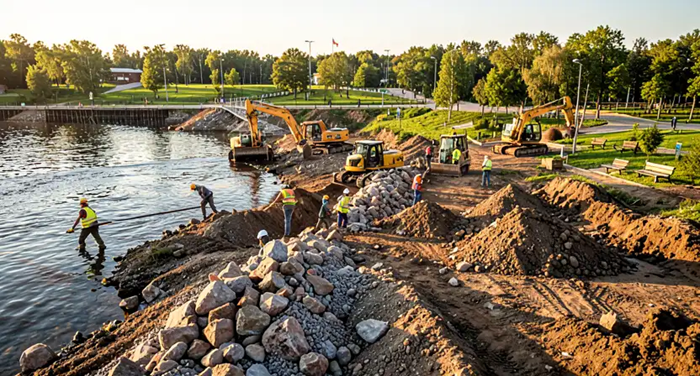
Information regarding the construction of an embankment begins with an understanding of the project’s goals: protecting the shoreline from erosion, providing safe access to the water, and creating a comfortable public environment.
The introduction outlines the regulatory requirements and engineering constraints that shape the embankment’s future appearance, as well as the importance of hydrological calculations, soil geology, and compliance with environmental regulations.
Next, the key implementation stages are examined: preliminary surveys, development of the concept and design documentation, approval processes, site preparation, construction of bank reinforcement and foundations, installation of utility networks, laying of surfacing and installation of railings and lighting, and final landscaping and planting. Special attention is paid to quality control and safety—both during construction and subsequent operation—to ensure the embankment remains resilient against structural loads and seasonal fluctuations in water levels.
Regulatory requirements and legal constraints for waterfront construction
Embankment construction and landscaping projects fall under a highly regulated category of activity, as they impact water bodies, the shoreline, and adjacent areas. The legal framework governing such work is primarily determined by water and land legislation, as well as urban planning regulations and environmental protection requirements.
Before design work begins, it is essential to establish the legal status of the water body and the coastal area. This includes identifying the presence of water protection zones and coastal buffer strips, as well as determining whether the site is classified as public land or subject to special land-use conditions.
These parameters directly influence the feasibility of permanent construction, the placement of utility networks, the nature of bank reinforcement, and the scope of permitted activities. A key constraint relates to water protection zone regulations; within these boundaries, prohibitions or significant restrictions may apply to the siting of facilities, soil stockpiling, the establishment of machinery parking areas, water discharge, and other actions that could lead to pollution or alterations in the hydrological regime. Additionally, requirements regarding the preservation of the natural shoreline, slope stability, floodwater conveyance, and erosion prevention are taken into account and reflected in the bank reinforcement design solutions. If plans include dredging, channel modification, or the construction of piers, retaining walls, stairways to the water, or other structures that could affect the water area or shoreline-forming processes, the project must include a justification regarding safety and the impact on the water body. Confirmation is often required that the proposed solutions will not impair water usage conditions, obstruct navigation (where applicable), or infringe upon the rights of third parties regarding access to the water and use of the shoreline within the established regulatory framework. Particular attention is paid to whether the site is prone to flooding or erosion; such areas typically require engineering surveys, calculations of water levels, and analyses of flood events and ice phenomena. This is important not only for structural reliability but also for the legal compliance of the facilities, as construction in flood-prone areas and high-risk zones may entail additional restrictions, protective measures, and special operating conditions.
Approvals, permitting procedures, and oversight
Typical items subject to approval and inspection
Approval procedures begin with the preparation of initial permitting documentation and engineering surveys; without reliable data on geology, hydrology, and the boundaries of zones with special land-use conditions, it is impossible to successfully pass the expert review and obtain a building permit. Depending on the scale and nature of the work, requirements may include developing design documentation, undergoing state or non-state expert review, and completing environmental procedures if the project is likely to have a significant environmental impact.
For projects near water, approvals often cover water usage and the use of the shoreline strip, compliance with aquatic bio-resource protection requirements, and regulations regarding the handling of excavated soil and construction waste. Oversight ensures that temporary structures and construction sites are not located in prohibited areas, do not create unauthorized access points to the water, and do not cause surface water pollution during construction.
-
- Land rights: confirmation of the legal basis for land use, as well as compliance with the permitted use category and urban planning regulations.
- Regulated zones near water: consideration of water protection zones, coastal protective strips, public shoreline strips, and other zones with special land-use conditions.
- Water usage: requirements for contracts, official decisions, or other legal grounds for using the water body and performing work that affects the water area or shoreline.
- Environmental requirements: measures to prevent pollution, control water turbidity, protect soil, and minimize impact on flora and fauna.
- Construction supervision: adherence to bank stabilization techniques, safety requirements, and design specifications—particularly regarding structural stability and hydraulic capacity.
In practice, legal risks most often arise from commencing work before mandatory procedures are completed, incorrectly defining the boundaries of regulated zones, or making on-site design changes that effectively constitute a new intervention in the water body. To reduce the likelihood of work stoppages and sanctions, it is crucial to document the baseline condition, maintain a transparent work log, provide timely notifications, and implement the environmental protection measures stipulated in the design and approval conditions.
- Pre-design assessment: legal status of the land and water body, restrictions and encumbrances, and regulated zones.
- Surveys and design: hydrology, geology, stability calculations, construction organization plan, and water protection measures.
- Approvals and expert review: obtaining necessary clearances and undergoing expert review where required.
- Permitting and construction: executing work within the scope of approved plans, adhering to conditions, and ensuring quality control.
- Commissioning and operation: acceptance, as-built documentation, and compliance with site regulations and embankment maintenance protocols.